
Best Chai in Odisha: 7 Spots Worth the Detour
Chai in Odisha is not one thing. From Puri beach counters to the Bargarh kulhad bars and Bhubaneswar morning carts, here are seven…
Leaf ratio, boil time, milk timing and the order everything goes into the pot. The exact method behind our Bargadiya Special, written down instead of folklore.
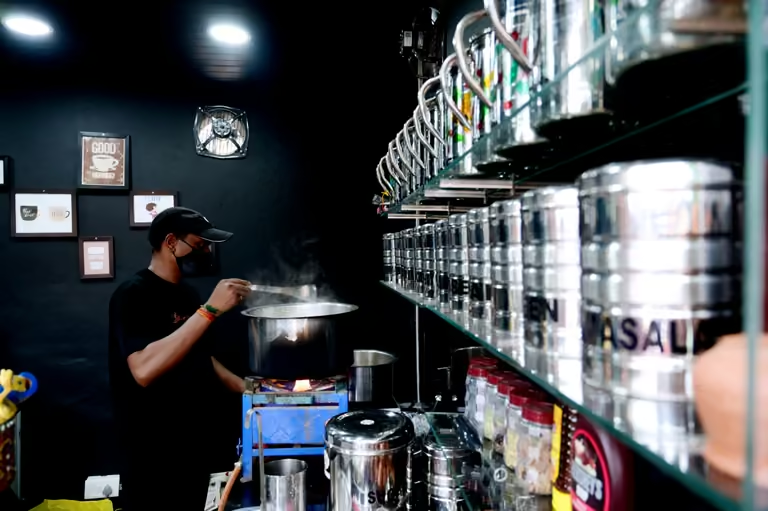
Everybody in Bargarh has an opinion about how chai should be made and almost nobody has written their method down. This is ours, in full, so you can either copy it or argue with it on the evidence.
Boiling, not infusing. Leaf, water, milk and sugar go into the same pot and the pot goes on a flame. The sugar reduces and caramelises slightly on the bottom, and the leaf gives up bitterness along with strength. Infusing and then adding milk produces a cleaner, sweeter, weaker drink — a different, and we would argue lesser, thing.
Two supporting details. The leaf is strong CTC Assam, not a leaf-tea blend, because a delicate leaf cannot survive a hard boil without turning bitter. And the milk goes in after the leaf has boiled, so the leaf has already given what it is going to give before the milk dilutes it.
Mostly volume and timing. A single cup is made exactly as above. A hundred cups go into a bigger pot with the same ratios, and the entire batch is poured into pre-warmed kulhads within ninety seconds of the sugar going in. The second we lose is the sugar sitting and dissolving.
The Bargadiya Special adds one thing to the method: roughly twice the ginger of a normal chai, cut into small pieces rather than crushed, so it holds its bite in the hot milk instead of dissipating in the boil.

Three things: the leaf is a strong CTC rather than a leaf-tea blend, it is boiled hard in the same pot rather than infused, and the sugar caramelises slightly at the bottom of the pot. Boiling is the big one — an infused tea and a boiled tea are different drinks.
A strong CTC Assam blend. Anything labelled leaf tea or speciality single-origin is too delicate for a hard boil and will turn bitter. We use a CTC Assam that we buy in 50 kg bags.
About four minutes of hard boil after the milk goes in, then two minutes of reduction. Total roughly six to seven minutes from cold water. If you boil it much longer you get bitterness from the leaf rather than sweetness from the reduction.
Yes. The method is identical, the only difference is the cup. A fresh unglazed terracotta kulhad costs around ₹20 to ₹40 new and measurably improves the tea, though any heatproof mug works fine for a first attempt.
Come try it
Both our Bargarh outlets are open 7:00 am to 11:00 pm, every day. Ask for the Bargadiya Special in a kulhad and see whether you agree with us.

Keep reading
Chai in Odisha is not one thing. From Puri beach counters to the Bargarh kulhad bars and Bhubaneswar morning carts, here are seven…
Kulhad chai is the reason people come to Bargarh. We compared the clay-cup counters on taste, price, consistency and authenticity,…
Bargarh does not have one chai counter, it has eight kinds of chai. A practical guide to plain boiled, masala, kawah, kulhad and t…